
PHASE 3 - SUBCONSCIOUS
NEURO CHANGE TRAINING
Phase 3 - Your Subconscious Mind
Automating Change and Goal Achievement
1. Core Concept
The subconscious mind is the automatic processing system that manages habits, emotions, and learned behaviours beneath conscious awareness.
It allows us to perform complex tasks effortlessly - once a pattern is learned, the subconscious takes over.
The goal of this module is to influence and reprogram the subconscious to make positive change automatic and sustainable.

2. The Subconscious in the Neuro Change Method
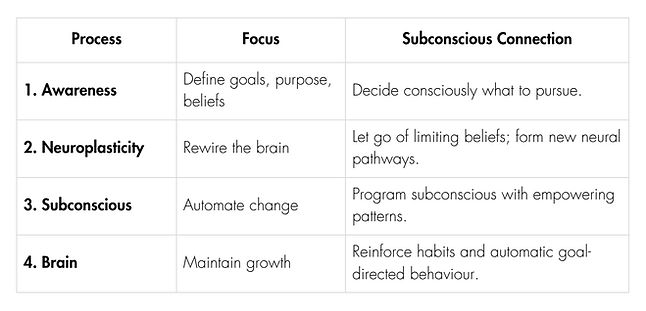
3. Automaticity and Habit Formation
-
Automaticity = performing actions without conscious effort (like driving or typing).
-
Repetition and emotional reinforcement train the subconscious.
-
Once goals and behaviours are habitual, the subconscious mind maintains them effortlessly.
-
“You are what you repeatedly do.”
4. Goal Achievement: From Intention to Implementation
Conscious goal setting isn’t enough — the subconscious must be instructed through clear plans and repetition.
Goal Intentions
-
General desires: “I want to get fit.”
-
These are conscious and abstract - often not enough to drive action.
Implementation Intentions
-
Specific “if–then” plans that create automatic responses to cues.
Example:-
If it’s 7 AM, then I will go for a 20-minute run.
-
If I feel demotivated, then I will remind myself of my purpose.
-
Implementation intentions transform conscious goals into subconscious routines.
5. Mental Contrasting
A technique that links vision and reality:
-
Visualize the desired future outcome.
-
Contrast it with the current reality and obstacles.
-
This strengthens motivation and primes the subconscious to act.
Example:
“I want to start a business” → imagine success → then contrast with current time limits and fears → identify clear steps to bridge the gap.
6. Overcoming Procrastination
Procrastination happens when the subconscious avoids discomfort.
To overcome it:
-
Identify the emotion linked to avoidance (fear, boredom, perfectionism).
-
Reframe short-term comfort vs. long-term gain (mindfulness practice).
-
Use implementation intentions to trigger action automatically.
-
Link effort to positive emotions -- satisfaction, relief, accomplishment.
7. Practical Tools & Activities
Activity 1 – Stop, Start, Continue
-
Stop actions that block goals.
-
Start new, helpful behaviours.
-
Continue what already works.
Then, turn insights into “if--then” plans.
Activity 2 – Pre- & Post-Mortems
-
Post-mortem: Reflect on past failures -- identify why a goal “died.”
-
Pre-mortem: Imagine future failure before it happens -- plan to prevent it.
Both clarify triggers and obstacles your subconscious needs to handle.
Activity 3 – Planning
-
Specify when, where, and how to act.
-
Planning with detail activates subconscious processing.
-
Example: “On Monday at 5 PM, I will call the client.”
-
Activity 4 – Automaticity Reflection
-
Notice tasks you already perform automatically.
-
Apply the same principle to goal behaviours.
Activity 5 – Long-Term vs. Short-Term Rewards
-
Reflect on the discomfort of action vs. the satisfaction of completion.
-
Use mindfulness to strengthen connection with long-term purpose.
8. Key Insights
-
The subconscious mind is goal-driven but literal -- it follows repeated instructions.
-
Conscious clarity + emotional energy = subconscious execution.
-
Implementation intentions act as mental code for automatic success.
-
Aligning subconscious habits with your purpose and beliefs creates consistency and ease.
-
Growth becomes natural when the subconscious and conscious mind work together.
9. Key Takeaways
-
The subconscious handles 90–95% of behaviour -- learn to program it consciously.
-
Automaticity saves cognitive energy for creativity and growth.
-
If–Then planning converts good intentions into consistent action.
-
Mental contrasting and mindfulness strengthen focus and reduce procrastination.
-
When purpose, beliefs, mindset, and subconscious align -- change becomes effortless and lasting.